
How Ed-Tech Harms Student Growth with Excessive Screen Time

Over the past two decades, classrooms around the world have undergone a dramatic transformation. Laptops replaced notebooks. Tablets replaced textbooks. Folders and binders were replaced by learning management systems. Educational technology (ed tech) was introduced with the promise of engagement, equity, personalization, and higher achievement.
Yet the academic outcomes many hoped for have not materialized.
In recent testimony before the U.S. Senate Committee on Commerce, Science, and Transportation, Dr. Jared Cooney Horvath, PhD, MEd, who is a teacher turned neuroscientist, argued that despite unprecedented access to schooling and digital tools, student performance in literacy, numeracy, attention, and higher-order reasoning has largely stagnated, or declined. His warning was clear: more technology does not automatically mean more learning.
This raises an uncomfortable but necessary question: Has the rapid expansion of ed tech harmed children’s cognitive development?
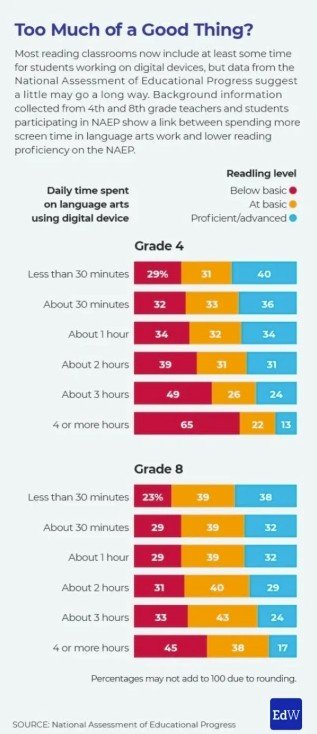
‘Too Much of a Good Thing’ chart from EdWeek
The Screen Saturation Problem
Students today are surrounded by screens. They complete assignments on tablets, take assessments on laptops, collaborate in shared documents, watch instructional videos, and use gamified apps for practice. Even homework is often digital.
Over half of children today use a computer at school for one to four hours each day. 25 percent spend more than four hours on screens during a typical seven-hour school day. Studies suggest that less than half of this time is spent actually learning, with students off-task for up to 38 minutes of every hour when on classroom devices.
The assumption behind this shift is that technology increases engagement and therefore improves learning. However, large-scale international assessments and meta analyses show the opposite pattern. Higher levels of classroom screen exposure are associated with weaker academic performance.
This does not mean all technology is harmful. It does mean that the cognitive costs of heavy screen use are real.
1. Fragmented Attention
Human brains are not designed for constant notifications, pop-ups, hyperlinks, and multitasking. Digital environments are engineered to capture and redirect attention. Each alert or visual shift competes for cognitive resources.
Deep learning requires sustained focus. When students are frequently task-switching their working memory becomes overloaded. This reduces comprehension and long-term retention.
Even when students appear engaged, their attention may be shallow compared to working with pen and paper.
2. Reduced Memory Encoding
Research comparing handwriting to typing shows that writing by hand activates broader neural networks associated with memory and conceptual processing. When students type, they tend to transcribe. When they write, they summarize and process.
This distinction matters. Encoding information deeply increases the likelihood it will move into long-term memory. Screens often encourage speed and surface-level interaction rather than deep reflection.
3. Weaker Reading Comprehension
Multiple studies have found that reading on paper results in stronger comprehension than reading on screens, particularly for longer or more complex texts. Digital reading environments encourage skimming. Students scroll, click, and scan rather than engage in slow, deliberate reading.
Over time, this can erode stamina for sustained reading, which is an essential skill for academic success. Some professors have noted that their freshman students hadn’t read an entire book from cover to cover prior to going to college.
4. Displacement of Developmentally Critical Experiences
Perhaps the most concerning impact is not what screens add, but what they replace.
When classroom time shifts toward digital platforms, it often reduces:
Face-to-face discussion
Collaborative problem solving
Discussion and debate
Physical writing and drawing
Manipulative-based math exploration
Hands-on projects
These skills are not nostalgic relics. They are developmentally aligned practices that strengthen executive function, social cognition, and fine motor skills.
If screens crowd them out, students lose opportunities to build foundational skills for professional and personal success in life.
Sweden’s Course Correction
One of the clearest real-world examples of this shift can be seen in Sweden.
In the early 2010s, Sweden embraced digitalization in schools aggressively. Tablets were widely distributed. Textbooks were replaced with digital materials. Classrooms became heavily screen-based.
The intent was progressive: prepare students for a digital future.
However, national and international assessments began to show troubling trends. Reading comprehension scores declined. Teachers reported decreases in focus and writing quality. Concerns grew about students’ foundational literacy skills.
By the early 2020s, Swedish policymakers began reversing course.
The Swedish government announced a renewed emphasis on printed textbooks, handwriting, and traditional literacy instruction, particularly in early grades. Funding was redirected toward physical books rather than digital devices. Officials publicly acknowledged that the push toward screens may have moved too quickly and without sufficient evidence.
This was not a rejection of technology altogether. It was a recalibration.
Sweden’s pivot underscores a powerful lesson: innovation must be evidence-based, not assumption-based.
Why the Promise Didn’t Match the Reality
Ed tech was marketed around several compelling claims:
Personalization improves outcomes
Gamification increases motivation
Digital natives learn differently
Technology prepares students for the workforce
Each claim contains partial truth. But none guarantees cognitive growth.
Personalization can support targeted skill practice, but many adaptive platforms emphasize speed and repetition over conceptual depth. They’re competing for attention, rather than retention.
Gamification increases engagement, but engagement is not synonymous with learning. A student can be highly entertained and minimally challenged.
The idea of “digital natives” suggests children’s brains are wired differently because they grew up with screens. Neuroscience does not support this claim. Human cognitive architecture has not changed in one generation.
As for workforce preparation, students certainly need digital literacy. But digital literacy cannot replace foundational reading, writing, and reasoning practices.
When Technology Helps
A balanced perspective is important. Technology can be powerful when used strategically and sparingly.
Evidence suggests benefits in specific contexts:
Assistive technology for students with disabilities
Targeted adaptive practice for well-defined skills
Access to simulations that cannot be replicated physically
Communication tools for collaboration across distances
The key is intentional use, not blanket integration.
Reclaiming Developmentally Sound Practices
If schools are to course-correct, several shifts may be necessary:
1. Prioritize Print in Early Literacy
Young learners benefit from physical books, handwriting, and phonics instruction that engages motor systems and sustained attention.
2. Protect Deep Reading Time
Students need structured opportunities to read longer texts without digital interruptions.
3. Restore Writing by Hand
Handwriting supports memory consolidation and idea organization. It should remain central, especially in elementary grades.
4. Limit Passive Screen Consumption
Videos and slide decks should supplement instruction, not dominate it.
5. Evaluate Technology Based on Learning Outcomes
Before adopting new platforms, schools should ask: Does independent research demonstrate meaningful academic gains?
The Bigger Picture: Growth Beyond Academics
Cognitive development is intertwined with emotional and social development. Excessive screen exposure has been linked in broader research to:
Reduced attention spans
Increased anxiety
Sleep disruption
Decreased face-to-face social interaction
While classroom technology is only one piece of the puzzle, schools influence daily habits significantly.
When educational spaces normalize constant screen use, they reinforce patterns that extend beyond the classroom.
Moving Forward with Caution and Clarity
The goal is not to romanticize the past or reject innovation. It is to align educational practice with how children actually learn.
Sweden’s reversal demonstrates that even well-intentioned reforms require adjustment when outcomes do not align with expectations.
Children’s brains develop through sustained attention, social interaction, and deliberate practice. When educational technology undermines these processes, it can slow growth rather than accelerate it.
If schools wish to cultivate strong readers, critical thinkers, and resilient problem solvers, the focus must return to evidence-based, developmentally sound instruction. In education, progress is not measured by how modern classrooms look. It is measured by how well children think, read, write, and reason. And that requires more than a device.